The Christmas card list behind Dunbar's number
An anthropologist counted Christmas cards and found the shape of our friendships. What Dunbar's number says, what it doesn't, and where 49 fits in.



In short
- Robin Dunbar predicted that people keep up about 150 meaningful relationships. A study of 2,984 Christmas cards found an average of 153.5.
- Those relationships sit in rings of roughly 5, 15, 50 and 150, each about three times the size of the one inside it.
- The inner rings need time and contact to stay close. Philos's 49 places sit at the ring Dunbar calls good friends.
Every December, millions of people sit at a kitchen table with a pile of cards and a list. Who gets one this year? Who got one last year and didn’t send one back? Who has moved, married or quietly drifted away?
That list turned out to be a scientific instrument.
A number from the monkey cages
In the early 1990s, the anthropologist Robin Dunbar was studying monkeys and apes. He noticed that species with a bigger neocortex, the thinking part of the brain, lived in bigger groups. Keeping track of who is friends with whom, who groomed whom and who owes whom a favour takes brainpower.
In 1993 he extended the line to humans. The size of our brains predicted a group of about 148 people: roughly how many relationships, he argued, we can keep up at once. Not names we recognise, but people we’d know, and know how they fit into our lives.
Counting Christmas cards
A number from primate brains needs testing on people, and Christmas cards turned out to be a good test. A card costs a little time, a little money and a stamp, so people mostly send them to relationships they care about.
Dunbar and his colleague Russell Hill gave questionnaires to households in Britain while they wrote their cards. For every card, people noted who it was for, how close they felt and when they were last in touch. They also listed everyone living in each household the card went to.
Forty-three households sent 2,984 cards between them, about 68 each. Counting everyone in the homes those cards reached, the average network came to 153.5 people, close to what the brains had predicted.
Not one circle, but rings
The more interesting finding came later, as Dunbar and others looked at how those relationships are arranged. They aren’t one flat crowd. They form rings, each about three times the size of the one inside it. In Dunbar’s own plain words:
- About 5: intimate friends, the people you’d turn to in a crisis.
- About 15: best friends.
- About 50: good friends.
- About 150: friends.
Think of the seating plan at a wedding. The top table is your five. The tables nearest the front are your fifteen. Everyone at the dinner is your fifty. And the evening party, when the dancing starts and the plus-ones arrive, is your hundred and fifty.
It’s a shape, not a rule
Dunbar’s number is a tendency, not a law. Dunbar himself describes 150 as a range, roughly 100 to 250, and some people have far more connections or far fewer. Other researchers argue the primate data can’t produce one precise number at all. What has held up well is the shape: a small, close centre and wider, looser rings around it.
The inner rings need tending
The rings also behave differently. In an 18-month study, Sam Roberts and Dunbar followed students as they left home for university. When contact dropped, closeness to friends fell faster than closeness to family. Friendships, they concluded, cost more to keep.
That’s the trouble with feeds that treat every connection the same. When your best friend’s news and an acquaintance’s holiday get the same tiny moment of your attention, the inner rings get less than they need.
Where 49 fits
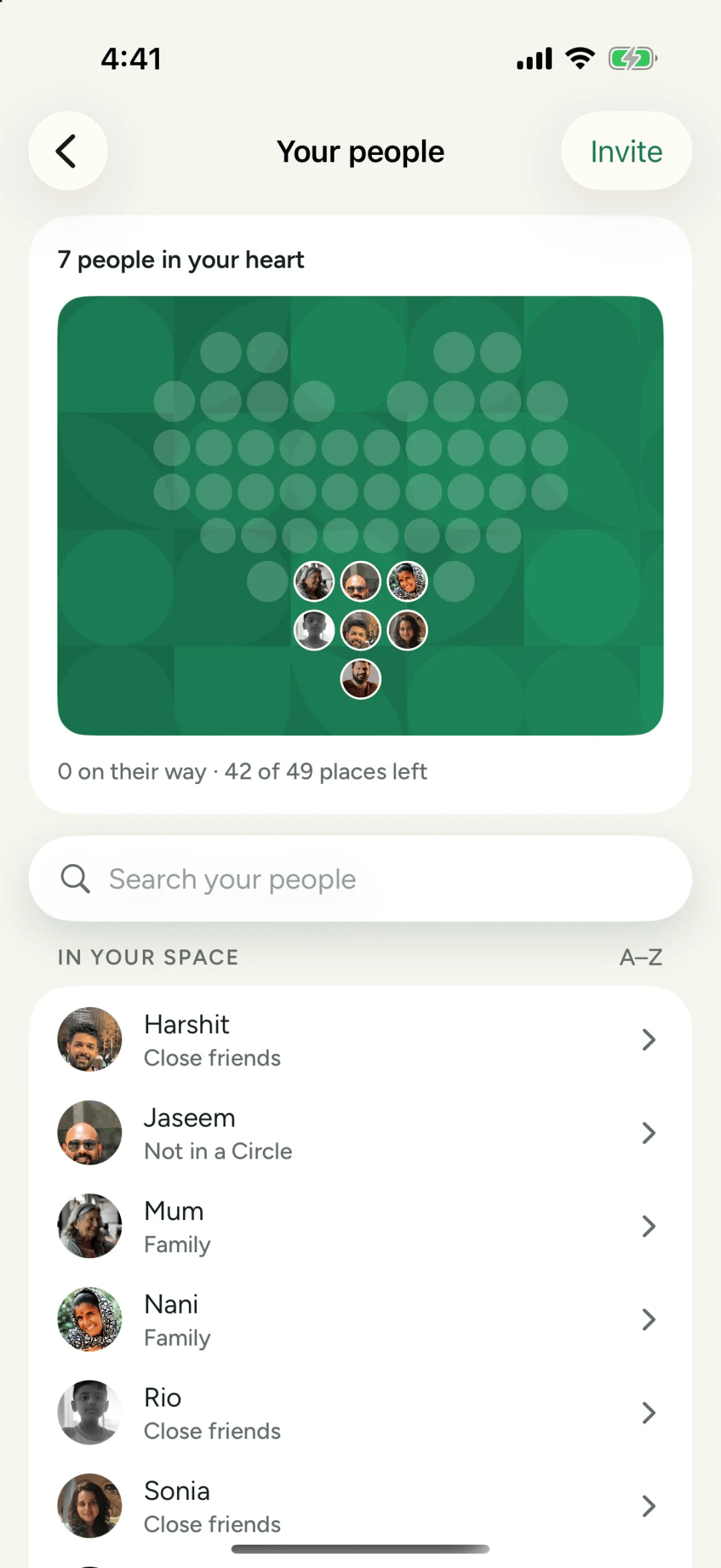
Philos gives you 49 places, which sits at the ring Dunbar calls good friends: roughly everyone at the wedding dinner. It’s a heart that fills one place at a time, so the first five are yours to choose, then the next ten, then the rest.
This week, try a small exercise. Write down the five people in your innermost ring. Then ask: when did I last talk properly with each of them? If the answer is “too long ago”, you know who to message first.
Questions people ask
What is Dunbar's number?
It's the idea, from the anthropologist Robin Dunbar, that most people keep up about 150 meaningful relationships at once. Dunbar himself describes it as a range of roughly 100 to 250.
Is Philos's limit of 49 based on Dunbar's number?
Philos gives you 49 places so that every one can be someone close. That happens to sit at the 50 ring in Dunbar's research, the people he calls good friends.
What are Dunbar's layers?
Roughly 5 intimate friends, 15 best friends, 50 good friends and 150 friends, each ring about three times the size of the one inside it.
Sources
- Coevolution of neocortical size, group size and language in humans, Robin Dunbar, Behavioral and Brain Sciences
- Social network size in humans, Russell Hill and Robin Dunbar, Human Nature
- Discrete hierarchical organization of social group sizes, Zhou, Sornette, Hill and Dunbar, Proceedings of the Royal Society B
- The costs of family and friends: an 18-month longitudinal study of relationship maintenance and decay, Sam Roberts and Robin Dunbar, Evolution and Human Behavior
- How many friends do most people have?, TED Ideas
- 'Dunbar's number' deconstructed, Lindenfors, Wartel and Lind, Biology Letters