Strong ties, weak ties: who belongs in your 49
The friend of a friend who found you a job, and the sister who'd drive through the night. Why you need both kinds of tie, and why Philos is built for the second.



In short
- Weak ties, the people you see now and then, bring news, ideas and opportunities. In a famous 1973 study, people who found jobs through contacts mostly heard from people they saw only occasionally or rarely.
- Strong ties, the few people closest to you, are who you lean on when life gets hard.
- A good life needs both. Philos is built for your strong ties; your weak ties can live everywhere else.
When he was a young sociologist, Mark Granovetter asked professionals in a Boston suburb who had recently changed jobs a simple question: how did you find out about this one? Many had heard about it through someone they knew. That part wasn’t surprising. The surprise was who.
Mostly, it wasn’t their best friends. Of the people who found their job through a contact, only 16.7% saw that person often. 55.6% saw them occasionally, and 27.8% rarely: an old colleague, a friend of a friend, someone from a previous job. In 1973 he published the result under a title that sounds like a riddle: “The Strength of Weak Ties”.
Why acquaintances bring the news
Granovetter’s explanation is elegant. Your close friends know the same people you know and hear the same things you hear. Your acquaintances move in other circles, so they’re the ones who carry something new into your life: a job, a flat, a recommendation, an idea.
Think of it as the difference between a net and a rope.
- Weak ties are a net. Wide, loose and cast far. They catch opportunities you’d never have seen.
- Strong ties are a rope. Short, strong and close at hand. They’re what you hold when you fall.
You need both, and they do different jobs.
Even small hellos matter
Weak ties aren’t only useful. They make us feel better too. In a study published in 2014, the psychologists Gillian Sandstrom and Elizabeth Dunn stopped people on their way into a Starbucks in Vancouver. Some were asked to be as efficient as possible. Others were asked to smile, make eye contact and have a short chat with the barista.
The chatty group came out in a better mood, and feeling more like they belonged. A brief chat with a stranger did that.
So say hello to the man at the market stall. Keep chatting to the parents at the school gate. That web of light connections makes a neighbourhood feel like home.
What the rope is for
But nobody calls the barista from a hospital waiting room. When your marriage is wobbling, when the scan results come in, when you get the job and want to scream, there are a handful of people you reach for. Researchers call them your strong ties. You’d probably call them your people.
Those relationships take the most time to build and the most attention to keep. They’re also the ones the modern internet serves worst. Feeds are built for reach, so your sister’s news sits between an acquaintance’s holiday and a stranger’s opinion, and gets the same tiny moment of your attention.
Why Philos is built for the rope
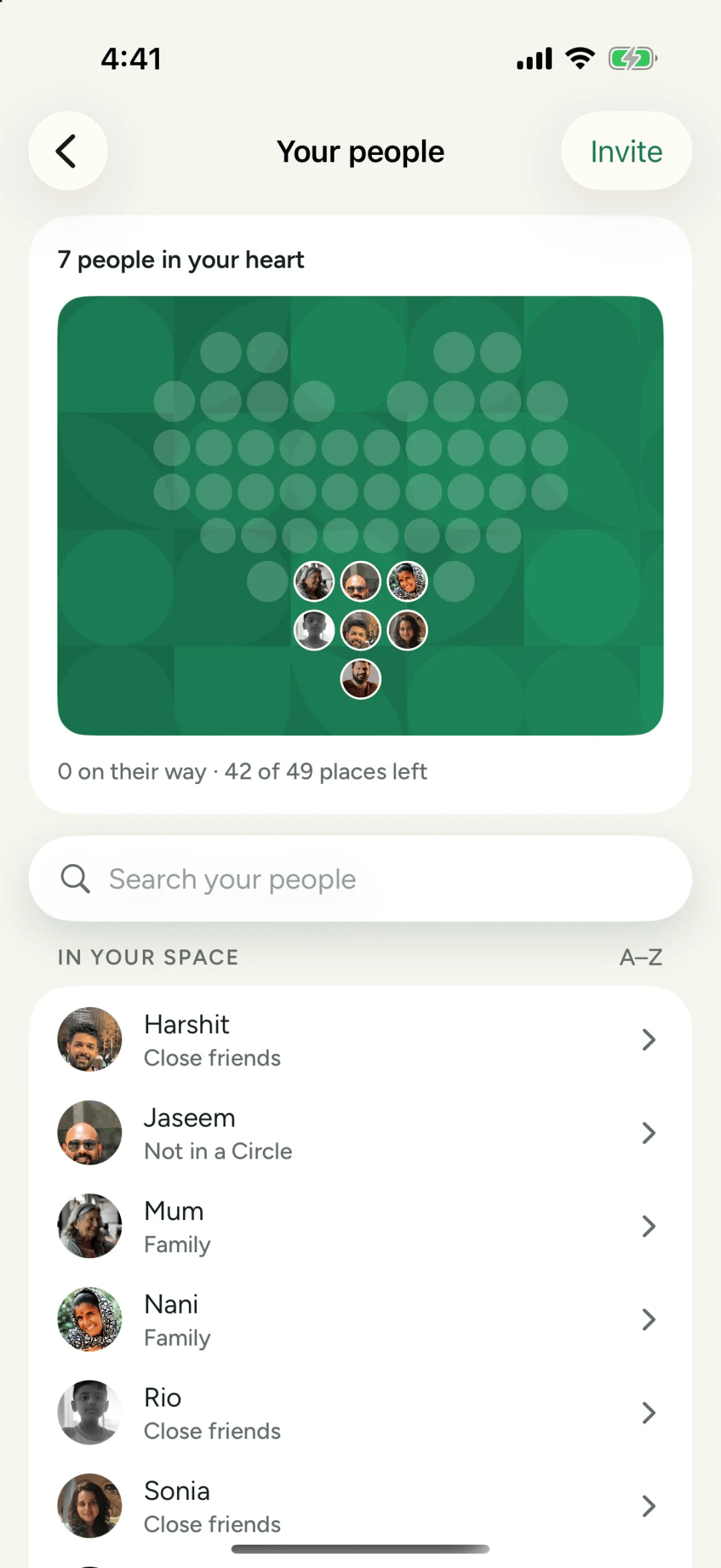
Philos has room for 49 people because it’s built for strong ties. It’s the rope, not the net. There are no followers, no friends of friends and no suggestions of people you might know. Every place is someone you’d want to hear from first.
That doesn’t mean your weak ties don’t matter. Keep them, everywhere else: at work, in your street, on the apps built for reach. Philos is the room for the people you’d call at three in the morning.
Before you add your next person, try a quick test: if something went wrong tonight, would I want them to know? If the answer is yes, they belong in your 49.
Questions people ask
Should I add acquaintances to Philos?
You can, but most people keep their 49 places for the people they'd call first. Acquaintances are easy to stay in touch with on public apps, at work and around town.
What is the strength of weak ties?
It's the sociologist Mark Granovetter's finding that acquaintances often bring us new information, like job openings, because they move in different circles from our close friends.
Sources
- The Strength of Weak Ties, Mark Granovetter, American Journal of Sociology
- Is Efficiency Overrated? Minimal Social Interactions Lead to Belonging and Positive Affect, Sandstrom and Dunn, Social Psychological and Personality Science