The living room and the town square
Social media turned our photo albums into speeches in a public square. Why the room you share in changes what you share, and why Philos is built as a living room.



In short
- Most social apps work like a town square. Philos is built like a living room, where only the people you invited can hear you.
- Research shows the size of the audience changes what we share. To a crowd we present ourselves; to one person we share what helps.
- A living room needs a door, walls and a host. On Philos that's 49 places, nothing public, and you deciding who's in.
In March 2019, the man who built the world’s biggest social network published a long post about where it had gone. For fifteen years, Mark Zuckerberg wrote, Facebook and Instagram had been “the digital equivalent of a town square”. What people increasingly wanted, he said, was something else: “the digital equivalent of the living room”.
He was right about the rooms. It’s worth asking what each one is for.
Two rooms, two ways of talking
Think of a real town square on a Saturday. Anyone can walk through. You raise your voice to be heard, and you choose your words for an audience you can’t see. What you say can be repeated by strangers who weren’t there.
Now think of your living room on a Sunday evening. Everyone in it is someone you invited. You can lower your voice. You show the blurry photos from the weekend, because the people looking at them were there, or wish they had been.
Here’s how the two map onto the apps on your phone:
- Who’s there. The square is open to anyone; the living room only to the people you let in.
- How you talk. In the square you perform; in the living room you just talk.
- What happens to your words. In the square they get repeated, screenshotted and forwarded. In the living room they stay in the room.
- Who decides. In the square, the loudest voices and the algorithm. In the living room, the host.
The room changes what we say
This isn’t only a feeling. In 2014, two researchers at the Wharton School, Alixandra Barasch and Jonah Berger, ran a series of experiments on how the size of an audience changes what people share. When people “broadcast” to many, they leaned towards things that made them look good. When they “narrowcast” to one person, they leaned towards what would help that person.
That’s the town square effect in one study. Put a family photo in front of hundreds of people and it quietly becomes a performance: the best angle, the right caption, a glance at the likes. Put it in front of the five people who love that child, and it’s just a photo of a child.
We moved our living rooms into the square
Most of us never chose this. The apps where we first shared baby photos and birthday dinners grew into places with followers, public profiles, share buttons and feeds picked by an algorithm. The album stayed where it was, and the square grew up around it.
So we do what people do in public. We hold back the honest stuff, post the highlights, and keep the real conversations for group chats that were never built for photos, memories or calm.
What a living room needs
When we designed Philos, we started from the room, not the feed. A living room needs three things.
- A door. Philos has room for 49 people, and someone only sees what you share once you’ve both added each other. There are no followers and no strangers.
- Walls. Nothing on Philos is public, and nothing can be forwarded. What you share with your people stays with your people.
- A host. You choose who sees every post. You can make room for someone new without a scene, and nobody else decides what’s on your Home.
The square still matters
None of this is against town squares. They’re where news breaks, debates happen and you discover the band you’ll love next year. A healthy life needs a few public places.
But your daughter’s first steps, your dad’s hospital update and the photo of the burnt birthday cake were never meant for the square. They belong in the living room.
Next time you’re about to share something, ask one question: who would I show this to if they were sitting next to me? Share it with them, and only them.
Questions people ask
Is anything on Philos public?
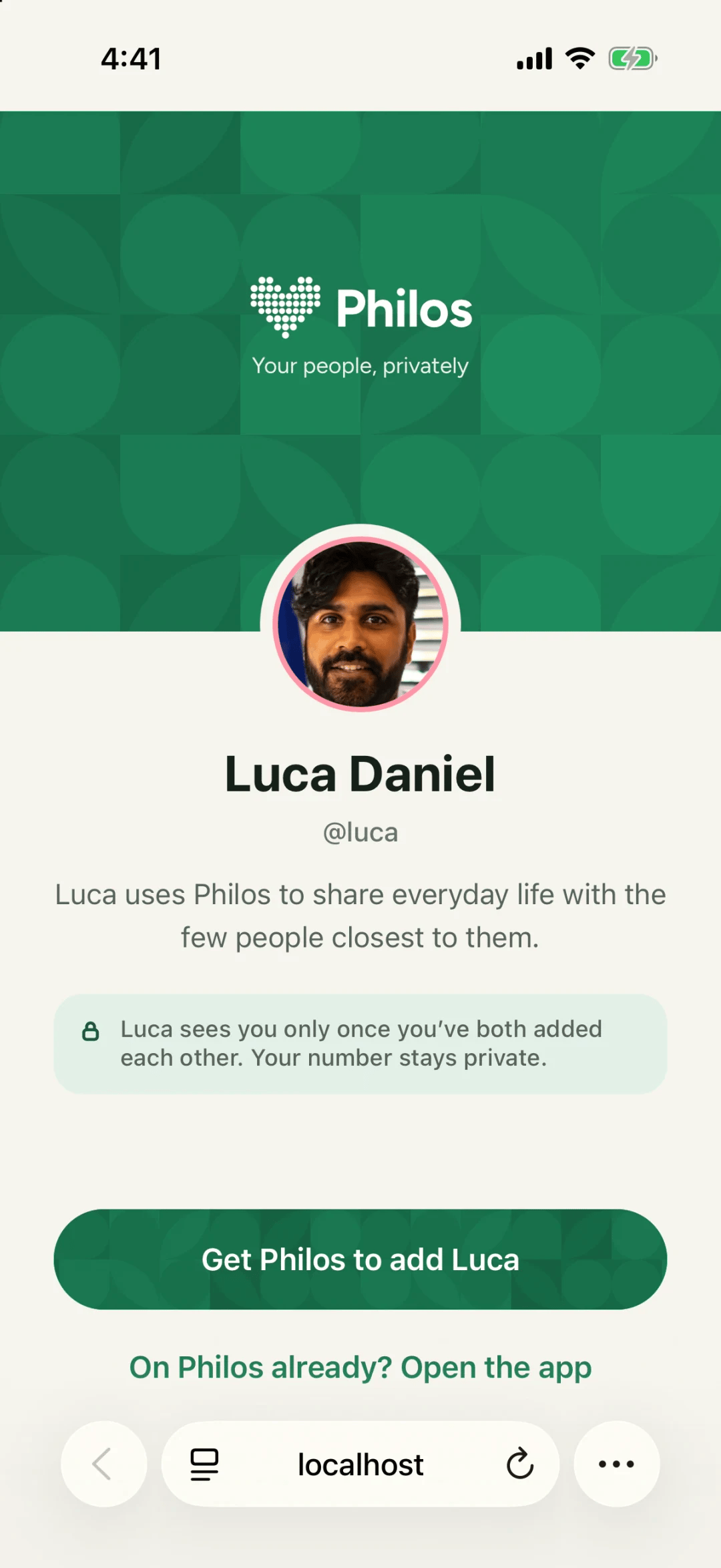
No. Every post and Moment goes only to the people you choose. Someone you haven't added sees only your name and photo on your link.
Can I follow people I don't know on Philos?
No. There are no followers. You see each other's posts only when you've both added each other.
Sources
- A Privacy-Focused Vision for Social Networking, Meta, 6 Mar 2019
- Zuckerberg wants messages to auto-expire to make Facebook a 'living room', TechCrunch, 6 Mar 2019
- Broadcasting and Narrowcasting: How Audience Size Affects What People Share, Barasch and Berger, Journal of Marketing Research